
Компания China Valve Packing Co., Ltd.
Understanding Flange Connections: Sealing Principles, Influencing Factors, and Maintenance Best Practices
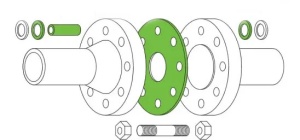
Understanding Flange Connections: Sealing Principles, Influencing Factors, and Maintenance Best Practices
China Industrial Valve Seal Kits Manufacturer Provides Low-Emission Valves and High-Performance Packing & Sealing Materials for Demanding Applications.Flange connections are one of the most widely used methods for joining components in industrial piping systems. Commonly found in pipelines, valves, and equipment, they rely on the combined action of bolts, flanges, and gaskets to achieve a tight seal and ensure safe fluid transmission. This article explores the sealing mechanisms, influencing factors, and maintenance strategies necessary for optimizing the performance and reliability of flange connections.
Sealing Principle of Flange Connections
At the core of flange connections lies the sealing mechanism, primarily achieved through the interplay of three critical components: bolts, flanges, and gaskets. Among them, the gasket is the key sealing element. When bolts are tightened, they apply a pre-tension force that compresses the gasket between the flange faces. This pressure causes the gasket to deform and fill the micro-irregularities on the sealing surfaces, thereby creating a leak-proof seal.
For effective sealing, the gasket must endure a certain clamping force, quantified as specific pressure. During operation, internal pressure can induce axial forces that tend to separate the flanges and elongate the bolts, reducing the clamping force on the gasket. If this force drops below the effective clamping threshold, the seal may fail, leading to leakage or even gasket blowout. Thus, maintaining a clamping force greater than the pipeline's operating pressure is essential.
Over time, the distance between sealing surfaces increases due to operational stresses. At this stage, gasket resilience becomes crucial. While plastic deformation is vital during initial sealing, elastic recovery of the gasket ensures continuous sealing performance under operating conditions.
Types and Characteristics of Flange Connections
Different flange types are suited for various pressures, media, and sealing requirements:
-
Flat Face Flange
-
Features: Simple structure, large contact area.
-
Limitations: Requires high pre-tension force; poor sealing at high pressures.
-
Applications: Suitable for non-toxic, non-flammable media under ≤2.5 MPa.
-
-
Raised Face Flange
-
Features: Facilitates gasket alignment, offers improved protection from erosion.
-
Limitations: Slightly harder to replace gaskets.
-
Applications: Widely used in high-pressure systems.
-
-
Tongue and Groove Flange
-
Features: Gasket fits into a groove, minimizing extrusion and corrosion.
-
Limitations: Complex structure; gasket replacement is difficult.
-
Applications: Ideal for high-sealing scenarios with toxic or flammable media.
-
-
Ring Joint Flange
-
Features: Excellent for high-pressure, high-temperature conditions.
-
Limitations: Demands high machining precision.
-
Applications: Typically used with necked butt-weld flanges in critical systems.
-
Factors Affecting Flange Sealing Performance
Flange sealing effectiveness can be compromised by several factors:
-
Operating Conditions
Pressure, temperature, and medium properties all impact sealing. Particularly in petrochemical environments, thermal cycling can significantly increase the risk of leakage. -
Gasket Characteristics & Specific Pressure
Even with identical materials, performance varies depending on gasket width, pre-tension pressure, medium type, and flange surface finish. Customization is often necessary in real-world applications. -
Bolt Pre-Tension Force
Proper bolt tension enhances sealing. However, over-tightening can damage the gasket or flange, reducing elasticity and risking failure. -
Gasket Material
The material must balance elastic and plastic deformation. High-quality, appropriately selected gaskets are crucial for long-term performance. -
Flange Stiffness
Inadequate flange stiffness may cause warping under stress, disrupting sealing. Proper flange design must consider flatness, surface roughness, and alignment.
Leakage Paths and Solutions
Flange leakage can occur via two main paths:
-
Permeation through the gasket material – now largely resolved with modern gasket technologies.
-
Gaps between gasket and flange surfaces – the most common leakage path.
To qualify as leak-tight, a flange connection must maintain a leakage rate below specified limits under operating conditions. If not, it's classified as leaking.
Flange and Bolt Interactions
The stress distribution in working flange assemblies is complex. Bolts and gaskets exert force on the flange, while internal pressure may induce deformation. While these forces often don’t threaten structural integrity, they can lead to sealing failures due to uneven deformation. Therefore, stiffness-based design is essential in addition to strength-based criteria.
Proper bolt tightening technique is vital. Using a crosswise, symmetrical tightening sequence ensures even compression, optimal sealing, and reduced installation time.
Maintenance and Inspection Tips
Regular maintenance is essential for maintaining flange performance and preventing failure:
-
Check Bolt Tightness Periodically
Thermal expansion and vibration can loosen bolts. Ensure they maintain specified pre-tension levels. -
Inspect Gasket Condition
Gaskets degrade over time. Check for wear, deformation, or aging and replace them as needed. -
Examine Flange Sealing Surfaces
Surface flatness and cleanliness are critical. Remove contaminants and verify the condition during each inspection. -
Monitor Flange Deformation
Warped flanges can compromise the seal. Detect and correct deformations early. -
Adapt to Changing Operating Conditions
Shifts in temperature, pressure, or media may necessitate adjustments in sealing strategy or material selection.
Conclusion
Flange connections are a cornerstone of industrial pipeline systems, essential for the safe and reliable transmission of fluids. By understanding their sealing mechanisms, influencing factors, and maintenance requirements, engineers and technicians can enhance both performance and longevity.
Successful application depends on:
-
Selecting the right flange type and gasket material.
-
Applying the correct bolt pre-tension.
-
Conducting regular maintenance and condition-based inspections.
Through rigorous design, careful installation, and proactive maintenance, flange connections can maintain their integrity even in demanding industrial environments—minimizing leakage risks and protecting both personnel and infrastructure. Know more about Google SEO Directory
Valve Packing Manufacturer, China Valve Seals, Valve Seal Kits, China Valve Manufacturer